
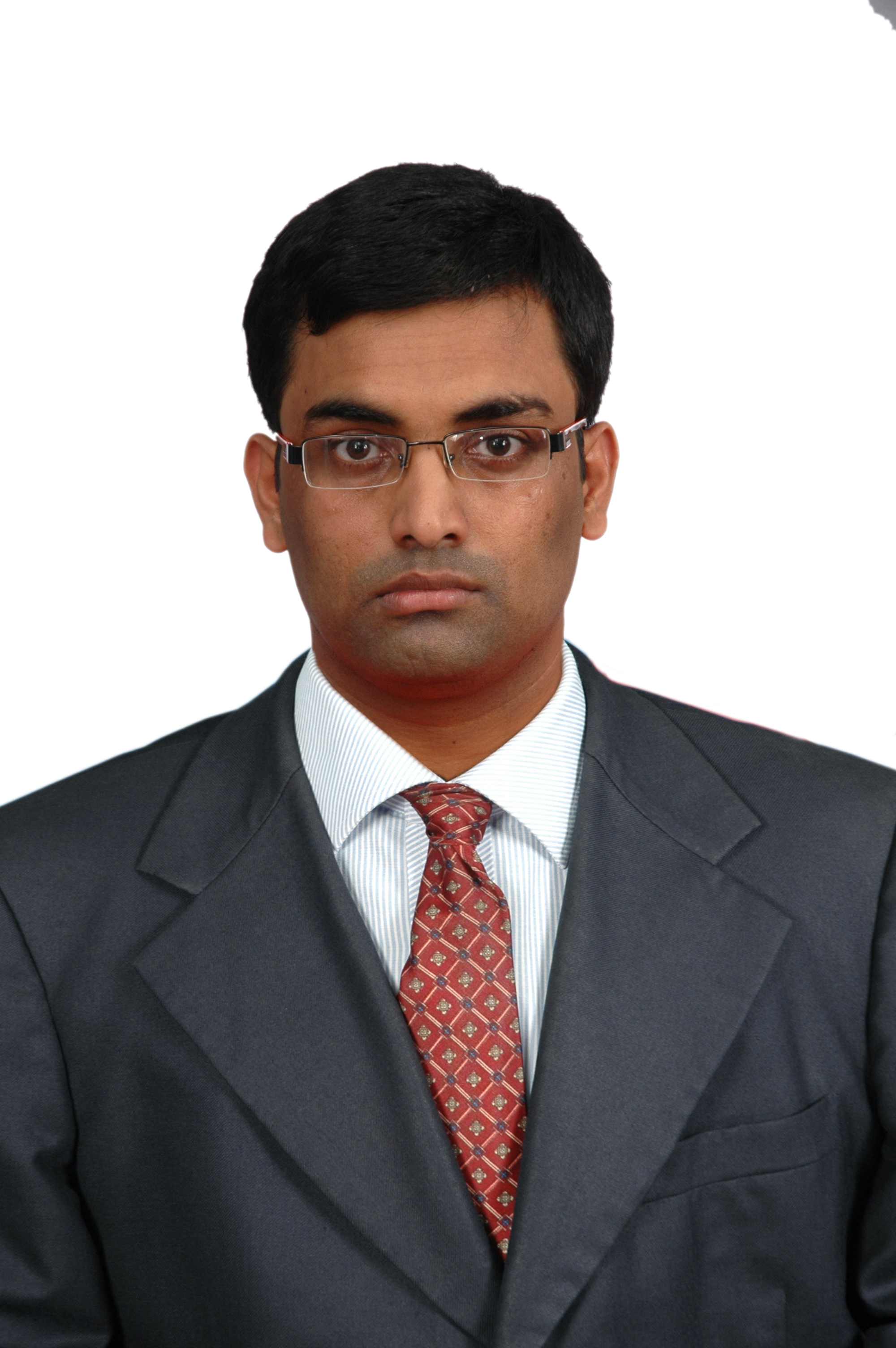
Dr Madan Kumar Lakshmanan
Senior Principal Scientist (Scientist-F)
- mklakshmanan.ceeri@csir.res.in
- Phone (o): 044-2254 4591
- Profile
- Academic Background
- Professional Background
- Research Areas
- Academic Contributions
- Technology Development and Industry Collaboration
- Publications and Intellectual Property
- Awards and Honours
- Collaboration Opportunities
Profile
Dr Madan Kumar Lakshmanan is a Senior Principal Scientist at CSIR-Central Electronics Engineering Research Institute (CSIR-CEERI), Chennai Centre, and an Associate Professor at the Academy of Scientific and Innovative Research (AcSIR). He has over 25 years of experience in research, technology development, and innovation spanning India and Europe. His research lies at the intersection of sensing, spectroscopy, signal processing, artificial intelligence, and data analytics, with an emphasis on developing intelligent systems to acquire and analyse data from real-world environments. His work spans biomedical, industrial, and environmental applications, including non-contact physiological monitoring, NIR-based material identification, plastic waste segregation, industrial sensing, and environmental monitoring. A significant aspect of his research has been the development of complete sensing and data-analysis solutions, covering sensor and instrumentation development, field data acquisition, signal processing, machine learning, system integration, and experimental validation. His work has resulted in technology development, intellectual property generation, industry collaborations, and the deployment and demonstration of solutions that address practical and national needs. Dr Lakshmanan received his PhD in Electrical Engineering from Delft University of Technology, The Netherlands, where his doctoral research on adaptive wireless communication systems was recognised with the NETELCOM Award for an innovative PhD contribution. He also holds an M.Sc. (Cum Laude) in Telecommunications from Delft University of Technology and a B.E. (Distinction) in Electronics and Communication Engineering from the University of Madras.
Academic Background
-
Ph.D. in Electrical Engineering, International Research Center for Telecommunications and Radar, Delft University of Technology, The Netherlands.
- Dissertation Title: Reconfigurable and Adaptive Wireless Communication Systems based On Wavelets Packet Modulators
-
M.Sc. in Telecommunications, Delft University of Technology, The Netherlands. -Graduated with Honors (CUM LAUDE).
-
B.E. in Electronics and Communications Engineering, University of Madras, Chennai, India. Graduated with DISTINCTION
Professional Background
Senior Principal Scientist (Scientist-F)
Central Electronics Engineering Research Institute (CSIR-CEERI), CSIR Madras Complex, Chennai. ( Present)
Senior Scientist
Central Electronics Engineering Research Institute (CSIR-CEERI), CSIR Madras Complex, Chennai.
Assistant Professor
Academy of Scientific and Innovative Research (AcSIR). (April 2012 – Present)
Scientist
Central Electronics Engineering Research Institute (CEERI), CSIR Madras Complex, Chennai. (April 2012 - December 2015)
Researcher
International Research Center for Telecommunications and Radar, Delft University of Technology, The Netherlands. (Sep 2006 – July 2011)
Project Officer
Media Lab Asia, Telecommunications And Computer Networks (TeNeT) Group,
Indian Institute of Technology, Madras (IIT-Madras), India. (Dec 2003- August 2004)
Systems Engineer
Polaris Software Labs Limited, Chennai, India. (July 2000 – Nov 2003)
Research Areas
- Near-Infrared (NIR) Spectroscopy and Hyperspectral Sensing
- Artificial Intelligence and Machine Learning
- Optical Sensing and Instrumentation
- Chemometrics and Multivariate Data Analysis
- Biomedical Signal Processing and Non-Contact Physiological Monitoring
- Field Data Acquisition and Intelligent Sensing Systems
- Embedded Intelligent Systems
- Environmental Monitoring and Sustainable Technologies
- Wireless and Reconfigurable Communication Systems
Current Research Focus
Dr Lakshmanan's current research focuses on the development of AI-enabled optical sensing and intelligent measurement systems for industrial and environmental applications.
His ongoing research includes:
- Intelligent plastic waste sorting and segregation using Near-Infrared Spectroscopy and Artificial Intelligence
- Portable and handheld spectroscopy-based systems for rapid plastic identification
- Field data acquisition and analysis for real-world sensing applications
- Non-contact physiological monitoring using photoplethysmography, video analytics, and machine learning
- Optical sensing solutions for circular economy and resource recovery
- Spectroscopy-driven industrial analytics
- Smart sensing platforms for environmental monitoring
- Data-driven decision systems for process automation
Research Leadership
Dr Lakshmanan leads and coordinates research and technology development programmes in intelligent sensing, spectroscopy, artificial intelligence, and sustainable technologies.
AI-Enabled Plastic Waste Sorting System
Principal Investigator of a multi-institutional programme focused on the development of high-throughput, AI-enabled optical sorting systems for plastic waste recycling and resource recovery.
The work integrates Near-Infrared spectroscopy, optical instrumentation, machine learning, embedded systems, mechanical systems, and process engineering. It involves extensive data acquisition from real-world plastic waste streams and the development of intelligent algorithms for material identification and segregation.
Handheld Plastic Identification Device
Principal Investigator of a government-funded project focused on the development of portable spectroscopy-based systems for the rapid identification of plastic materials in field environments.
The project combines compact optical instrumentation, spectroscopy, machine learning, embedded processing, and field data acquisition to enable rapid material identification outside conventional laboratory environments.
Field Data Acquisition and Intelligent Sensing
A significant aspect of Dr Lakshmanan's research has been the development and use of sensing systems for data acquisition under real-world operating conditions.
His experience spans biomedical and industrial applications, including physiological data acquired using wearable and non-contact sensing modalities, as well as field data collection for plastic identification and segregation. His work encompasses experimental design, sensor and instrumentation development, data acquisition, signal quality assessment, signal processing, feature extraction, machine learning, and validation of intelligent sensing systems.
This field-oriented approach enables the development of algorithms and sensing technologies based on practical data and operating conditions rather than relying solely on controlled laboratory datasets.
Biomedical and Non-Contact Physiological Monitoring
Dr Lakshmanan has worked on biomedical signal acquisition and analysis, including non-contact photoplethysmography (remote PPG/rPPG) and video-based physiological monitoring.
His work in this area has involved acquiring and analysing physiological signals using optical and video sensing modalities, signal processing, and data-driven techniques for remote and contactless monitoring. This research forms part of his broader interest in developing intelligent sensing systems that extract meaningful physiological information without conventional contact-based sensors.
Academic Contributions
As an Associate Professor at AcSIR, Dr Lakshmanan contributes to postgraduate education, doctoral research, and research training.
His academic activities include:
- Teaching Advanced Engineering Mathematics for PhD scholars
- Teaching Research Proposal Writing and Scientific Communication
- Doctoral supervision and research mentoring
- Membership in Doctoral Advisory Committees
- Guidance of undergraduate, postgraduate, and doctoral researchers Over the course of his career, he has mentored more than 50 students, interns, and research scholars.
Technology Development and Industry Collaboration
Dr Lakshmanan's research has involved the development of technologies in collaboration with industry, academic institutions, and government organisations. Selected areas of technology development include:
- AI-enabled plastic waste sorting and segregation systems
- NIR spectroscopy-based material identification and field data acquisition • Portable and handheld spectroscopy systems
- Non-contact photoplethysmography and physiological monitoring • Spectroscopy-based software for crude oil and downstream fluid analysis
- Online moisture monitoring systems for food processing industries • Remote healthcare analytics and physiological signal processing
- Solar energy estimation and analytics systems • Data science and automation platforms for banking and enterprise applications
- Reconfigurable wireless communication architectures His work has involved collaborations with organisations and research groups in India, Europe, Japan, and South Korea.
Publications and Intellectual Property
- More than 65 peer-reviewed journal and conference publications
- Patent applications in sensing, spectroscopy, and related technologies
- 5 Copyrights, of which 3 have been granted
- 3 Industrial Design Registrations, of which 1 has been granted
- Invited talks, technical presentations, and conference contributions
Awards and Honours
International
- NETELCOM Award, The Netherlands
- Royal Dutch/Shell Chevening Scholarship
- Erasmus Mundus Postdoctoral Fellowship
- Best Paper Award, IEEE GHTC
- PROMOOD Prize, Delft University of Technology
- Best Student Paper Award, WPMC Symposium
- Multiple International Travel Grants and Research Fellowships
National
- Runner-Up, National Awards for Technology Innovation, Government of India
- SERB-DST International Travel Fellowship
- Best Poster Award, ICRAFPT
- Invited Speaker Fellowships and Professional Recognitions
- On-the-Spot Excellence Award, Polaris Software Lab
Collaboration Opportunities
Dr. Lakshmanan welcomes research and technology-development collaborations with academic institutions, industries, start-ups, and government organisations in areas including:
- Artificial Intelligence for Spectroscopy
- Circular Economy and Plastic Recycling
- Sustainable Materials Processing
- Smart Sensors and Instrumentation
- Biomedical and Non-Contact Physiological Monitoring
- Field Data Acquisition and Intelligent Sensing
- Industrial Data Analytics
- Applied Machine Learning
- Optical Inspection and Sorting Systems